


Misinformation and fraud are increasing threats to older adults in today’s digital world. From viral fake news on social media to convincing relationship scams, older adults are increasingly targeted by bad actors who exploit their trust and vulnerability. The consequences range from self-misdiagnosis and viral sharing of “fake news” to devastating financial losses. This post explores the scope of the problem, why older populations are particularly at risk, and how a rigorous, scientific approach to detecting AI-driven deception can help protect this fastest-growing portion of the population.
A Growing Threat
Rising Fraud and Scams: Older adults face a rampant surge in online misinformation and fraud targeted directly at them. In recent years, scammers and purveyors of false information have increasingly put their sights on older adults—especially those over 70—through social media, email, phone, and other channels. The FBI’s Internet Crime Complaint Center reported that in 2023 Americans over 60 filed more than 88,000 fraud complaints, with total losses exceeding $3.4 billion – an 11% increase from the prior year [1]. These numbers are likely low estimates, since many scams go unreported due to shame or lack of awareness. In fact, in 2024 reported scam losses exploded to $12.5 billion (up 25% from $10 billion in 2023), with older adults hit the hardest [2]. The Federal Trade Commission (FTC) estimates that because most frauds aren’t reported, actual losses to older consumers in 2023 may have been as high as $61.5 billion [3]. Older adults not only lose money more frequently, but also in greater amounts – adults in their 70s reported a median loss nearly 2.5 times higher than victims in their 20s [2]. Such financial losses can be devastating for retirees on fixed incomes, sometimes wiping out years of savings.
Misinformation and Older Audiences: Beyond monetary scams, misinformation (false or misleading information) also disproportionately affects older adults. Research has found that older Americans are far more likely to share “fake news” articles on social media than younger people [4]. In one study of Facebook users during the 2016 U.S. election, 11% of users over age 65 shared links from false news sites, compared to only 3% of users aged 18–29 [5]. In fact, those 65+ shared nearly seven times as many fake news articles as the youngest group. This pattern held true regardless of education, gender, or party – age was the strongest predictor of sharing misinformation. While most older adults do not spread false content, clearly there is a disproportionate subset that is being misled and propagating it further. Such misinformation ranges from health myths to political rumors, which can have harmful real-world consequences (for example, bogus medical cures or distorted voting decisions).
Why Older Adults Are Targeted: Unfortunately, scammers and propagandists often view older individuals as ideal targets. Criminals assume many of them have accumulated savings or home equity, making them lucrative marks [1]. They also exploit characteristics sometimes associated with aging: a trusting nature, loneliness, or cognitive decline. Many older adults live alone or struggle with health issues, which scammers interpret as opportunities – there may be no one else around to warn them, and victims may be more receptive to someone offering “help” or urgent advice. A representative case is tech support scams, where a con artist impersonates a technician and convinces a senior that their computer or bank account is in peril. In 2024, adults 60+ were five times more likely than younger adults to report losing money to tech support scams, and nearly three times more likely to fall for prize or lottery scams [3]. Social isolation and generational gaps in digital literacy make it easier for fraudsters to deceive older adults about what’s real or fake online. If you are interested in knowing more about the range of issues that contribute to older adults’ greater susceptibility to misinformation, please check out this great journal article by Drs. Nadia Brashier and Daniel Schacter [11]. All these factors create a perfect storm that malicious actors eagerly exploit.
From Fake Calls to AI Voice Clones: New Tactics
Traditional scam techniques (like phishing emails or phone impostors) remain common, but a new layer is making them even more dangerous: artificial intelligence. Modern scammers are now leveraging AI tools to craft highly believable deceptions at scale [6]. A recent FBI warning noted “attackers are leveraging AI to craft highly convincing voice or video messages and emails to enable fraud schemes”[7]. In plain terms, criminals can clone voices, generate fake images or videos (known as deepfakes), and write flawless messages – all automatically. These AI-generated fakes are often startlingly authentic, making it much harder for an average person (or even an expert) to recognize the fraud.
Impersonating Loved Ones: Consider the frightening emergence of voice cloning scams. With just a short audio sample (perhaps stolen from a social media video or voicemail), AI can reproduce someone’s voice mannerisms. Scammers have used this to call grandparents, speaking in a voice identical to their grandchild and claiming an emergency (like being arrested or hospitalized) to beg for money. In one real case, a criminal cloned a couple’s voices and staged a fake kidnapping call – their family friend received a call that sounded exactly like her elderly relatives in distress, when in fact those voices were AI-generated mimics [6]. For a trusting senior, it’s easy to see how hearing a loved one’s voice pleading for help would override skepticism. Family impersonation scams have long preyed on grandparents (“Grandma, it’s me, I need money”), but AI voice cloning turbocharges the deception. Notably, consumers 80 and older already lost 53% more to “family/friend impersonation” scams than younger adults even before voice cloning became common [3]. With AI, such scams become more convincing and thus more dangerous.
Deepfakes and Misinformation: AI doesn’t stop at audio – deepfake videos and images are also on the rise and are catching consumers off guard. Using artificial intelligence, fraudsters can create fake videos of people seemingly saying or doing things they never did. This is not just re-editing real footage, but complete fabrication. This technology has been used to create false messages from public figures, from celebrities to politicians. A famous example was when filmmaker Jordan Peele released a deepfake video of President Obama in 2018, putting realistic simulated words in his mouth as a warning about this technology [6]. For older adults who grew up on TV-centered mass media, the idea that video evidence can be faked so perfectly may be harder to fathom than it is for younger generations, who grew up on user-generated content. As a result, they may be more likely to believe a viral fake video (for instance, a bogus clip of a government official making a shocking statement) – and perhaps share it or act on it, as noted in the social media sharing research cited above. In a 2019 Pew Research Center survey, before the AI boom, nearly two-thirds of Americans (63%) already said that altered videos and images create “a great deal of confusion” about current events and about 6 in 10 U.S. adults admitted that it’s too much to expect the average person to reliably recognize doctored media [8]. This concern is increasing as AI infiltrates, and it is global. In 2025, Pew Research Center data showed that more than eight-in-ten adults across 35 countries think that made-up news is a big problem in their country (87% in the U.S.), including 59% who see it as a very big problem [9].
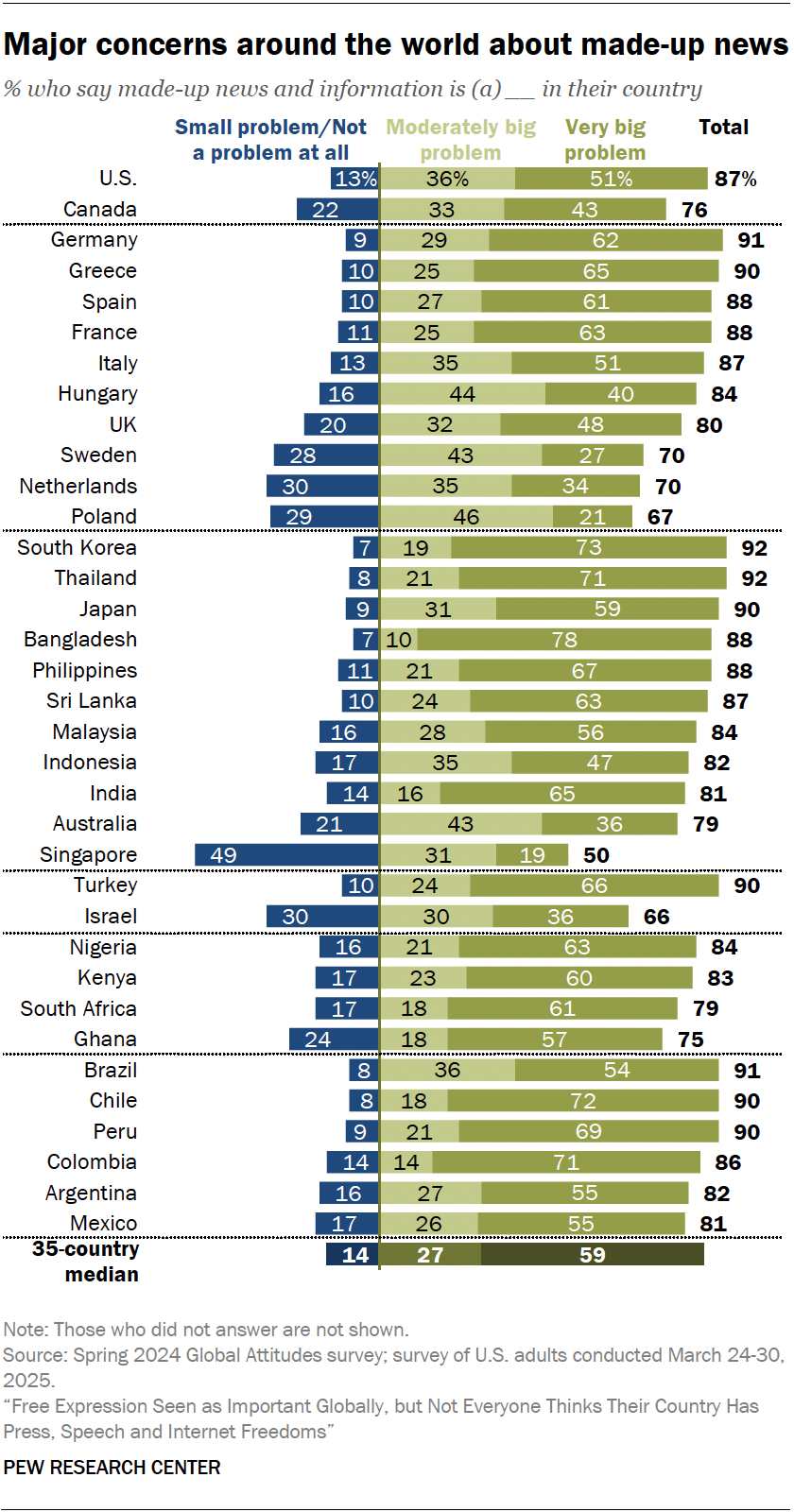
In short, advanced fakes can fool anyone, but data shows that older adults tend to be at higher risk of being duped by these new forms of misinformation and resharing to others.
Real Consequences: The fallout from these scams and falsehoods is very real. Aside from the billions in financial losses, there is a toll on mental health and trust. Victims like 90-year-old Phyllis (who lost $20,000 to fake tech support thieves) are left feeling violated and unsafe in their own homes [1]. Others become embarrassed or fearful of using technology at all after being scammed, exacerbating social isolation, which is a critical health concern. Misinformation can mislead consumers into poor decisions – for example, rejecting legitimate medical treatments due to an online hoax, or being misinformed about important issues when voting. Criminals targeting older adults are constantly evolving their social engineering… they replicate the communications of reputable organizations to fool people [1]. This erosion of trust means older adults—and, indeed, all of us—may start doubting even genuine communications from their bank, doctor, or family, unsure what is real. Clearly, we need solutions that address both the symptoms and root causes of this problem. Education and awareness are vital – but so are better tools to detect and flag deceptive content before it reaches vulnerable individuals.
Why a Scientific Approach Offers Hope
Tackling AI-driven misinformation and fraud requires innovation equal to the scammers’. This is where a scientifically rigorous, technology-based approach becomes our best ally. Government agencies and researchers are already advocating for this. A Federal Reserve expert recently pointed out that one of the “best tools to stop thieves who use generative AI…is AI” deployed for detection and defense [10]. In practice, this means developing advanced detectors that can analyze content (text, images, audio, video) for telltale signs of manipulation or artificial origin, especially recognizing the difference between humans and deepfakes.
At Moveris, our scientific approach reads biological signals like blood flow and facial muscle movement, and how they work together, to assess the likelihood that the person on the other side of the screen is, indeed, real. Unlike a human, who might be fooled by a deepfake, our MoverisMedia platform is trained on thousands of fake vs real videos and can parse out tiny details that humans gloss over.
Introducing MoverisMedia—a human “liveness” detection platform: Our team at Moveris has embraced this challenge by using decades of research in psychophysiology, cognitive science, and media research to develop the MoverisMedia platform. This new platform offers consumers, media and news organizations, and others a powerful tool to authenticate human-ness. Our solution was built specifically to identify AI-generated and misleading content in real time. What makes our approach different is the scientific rigor and multi-faceted methodology behind it. Moveris was founded by experts with decades of research experience, including PhDs who have worked on understanding human communication and digital behavior. This expertise shapes how we detect misinformation: rather than relying on shallow tricks or black-box algorithms, we use validated techniques and constantly update our methods as new threats emerge.
Our platform uses advanced computer vision to analyze lighting, shadows, and facial movements to distinguish real footage from deepfakes. All these techniques are rooted in peer-reviewed research and extensive testing to minimize false alarms. While no system is perfect, our scientific approach yields highly accurate results, filtering out noise. And importantly, we present results in an accessible dashboard, so that even less-technical users (or their caregivers) can get clear insights.
Empowering Older Adults: Tools like ours are not meant to fully replace human judgment, but to enhance it. By deploying real-time AI detection, older adults, senior centers, families, and financial institutions can create an additional layer of defense.
Crucially, a scientific solution brings credibility. Our approach at Moveris emphasizes transparency – we explain why something was flagged, helping users learn the red flags themselves. This educational feedback loop can gradually improve digital literacy among everyone, including older adults, making us less likely to fall victim in the first place.
In combating misinformation and fraud, knowledge truly is power. We must continue to spread awareness about new forms of scams, promote skepticism of “too good to be true” offers, and encourage families to talk openly with their loved ones about online safety. At the same time, we have powerful new allies in technology. MoverisMedia is one such ally – a platform designed to scientifically detect AI-driven fakes and flag fraudulent content before it causes harm. By integrating solutions like this into outreach and education efforts, we can start to turn the tide against those who prey on consumers.
The goal is simple: empower older adults (and everyone else too!) to enjoy the benefits of the digital age without falling victim to its pitfalls. With a blend of smart technology and compassionate education, we can safeguard our golden years from the scourge of scams and misinformation. To learn more about how MoverisMedia works and how it can be implemented to protect your community or organization, reach out to us or visit our website. Together, we can build a safer information environment for everyone.
Citations:
[1] National Council on Aging (2024) – What Are the Top Online Scams Targeting Older Adults?
[2] AARP (2025) – $12.5 Billion Reported Lost to Scams and Fraud in 2024, Older Adults Hit Hard
[3] Federal Trade Commission (2024) – Protecting Older Consumers 2023–2024
[4] Princeton School of International & Public Affairs (2019) – Fake News Shared by Very Few, But Those Over 65 More Likely to Pass on Such Stories, New Study Finds
[5] Andrew Guess, Jonathan Nagler, and Joshua Tucker (2019) – Less than you think: Prevalence and predictors of fake news dissemination on Facebook
[6] National Council on Aging (2024) – What Are AI Scams? A Guide for Older Adults
[7] Federal Bureau of Investigation (2024) – FBI Warns of Increasing Threat of Cyber Criminals Utilizing Artificial Intelligence
[8] Pew Research Center (2019) – Many Americans Say Made-Up News Is a Critical Problem That Needs To Be Fixed
[9] Pew Research Center (2025) – Free Expression Seen as Important Globally, but Not Everyone Thinks Their Country Has Press, Speech and Internet Freedoms
[10] Federal Reserve Bank of Boston (2023) – Synthetic identity fraud: How AI is changing the game
[11] Nadia M. Brashier & Daniel L. Schacter – Aging in an Era of Fake News, Current Directions in Psychological Science 2020 May 19;29(3):316–323. DOI: 10.1177/0963721420915872
Put a living face behind the next yes.
Tell us where you need a living-face decision. We will show you Moveris on your own flow.
